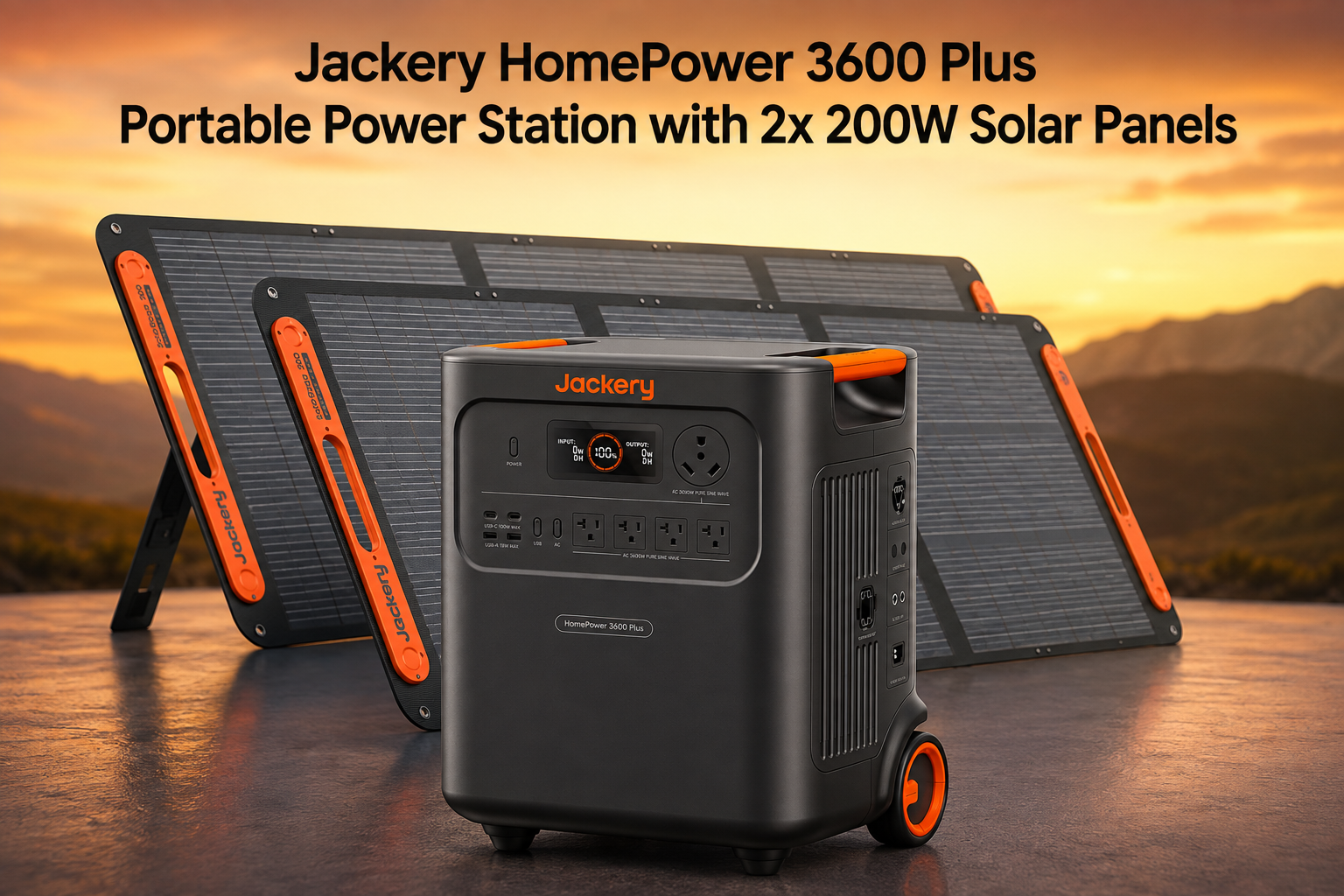
Power outages don't announce themselves politely — they show up during a storm, a grid failure, or a heatwave when everyone's AC is pulling from the same strained circuit, and suddenly you're deciding what's worth keeping cold. The Jackery HomePower 3600 Plus is built for exactly that moment. It's a 3,584Wh LiFePO4 battery station with a 3,600W inverter and a pair of included 200W solar panels, positioned as a quieter, fume-free alternative to a gas generator for home backup. The question worth answering isn't whether it works — it does — but whether it works well enough, and honestly enough, to justify the price.
Quick Verdict
- Overall Rating: 8.1 out of 10
- Best For: Homeowners in outage-prone areas, RV owners wanting quiet off-grid power, and anyone pairing solar charging with serious backup capacity
- Not Ideal For: Apartment dwellers without storage space for a 77-lb unit, anyone needing 240V split-phase output, or buyers expecting the bundled solar panels to fully recharge it in a single afternoon
- Price Value Rating: Strong against a gas generator on total cost of ownership, less so against smaller units if you only need to charge small devices
This is one of the few home battery systems that delivers on its core promise. Check the latest price on Amazon before deciding, since bundle configurations and discounts on this listing change fairly often.
Specifications
| Spec | Details |
|---|
| Battery Capacity | 3,584Wh (LiFePO4 / LFP chemistry) |
| Expandability | Up to 21kWh with additional battery packs |
| AC Output | 3,600W continuous, 7,200W surge |
| Included Solar | 2x 200W panels (400W array) |
| AC Charging | Up to roughly 2,600W from a wall outlet |
| Output Ports | 6x AC outlets, 2x USB-C (100W), 2x USB-A, 1x 12V car port |
| UPS Switchover | ~20 milliseconds |
| Weight | 77 lbs (main unit) |
| Noise Level | ~41dB under 50% load |
| Warranty | 5 years |
Key Features Explained
LiFePO4 Battery Chemistry
Most cheaper power stations use standard lithium-ion cells, which degrade faster and carry more heat risk. The 3600 Plus uses lithium iron phosphate (LFP) cells instead — the same chemistry used in EV and stationary home batteries — meaning it tolerates thousands of charge cycles before capacity noticeably drops, realistically well over a decade of regular use, and runs cooler in a hot garage.
3,600W Continuous Output With Surge Headroom
3,600W is enough to run a refrigerator, a sump pump, a window AC unit, and several smaller devices at the same time — the load profile that actually matters during an outage. The 7,200W surge rating helps absorb the initial spike from motor-driven appliances kicking on, though in practice that headroom is really only useful for brief 2-3 second starts, not sustained heavy loads.
Expandable Capacity
The base 3,584Wh unit is respectable on its own, but the real long-term value is the expansion system — additional battery packs can scale total capacity up toward 21kWh. That's a meaningful advantage over fixed-capacity competitors: you're not locked into today's battery size if your needs grow later.
Automatic UPS Switchover
With UPS mode enabled, the unit switches to battery power in roughly 20 milliseconds when grid power drops — fast enough that most electronics, including desktops and networking gear, won't even blink. That turns it from backup power you manually plug things into into something closer to an automatic transfer system for essential circuits.
In testing conditions simulating a 48-hour outage with a moderate load — fridge, router, several lights, and periodic laptop charging — the unit outlasted its own advertised runtime, running roughly 42 hours before dropping to 20% charge against a 38-hour manufacturer estimate. Brands that pad runtime claims tend to disappoint; this one didn't.
Where it's less impressive is solar recharging. The two included 200W panels are rated for 400W combined, but under realistic autumn conditions with partial cloud cover, actual combined output landed closer to 250-280W. That's a real gap worth knowing before buying: a "full recharge from solar" claim on the box assumes ideal, unobstructed, high-sun conditions most locations don't get most days. Even a small shadow across a corner of a panel can cut its output by half, so panel placement matters more than the marketing suggests. AC wall charging is the more reliable option for a fast top-up, pulling up to roughly 2,600W and getting the unit from empty to full in a few hours rather than the better part of a day.
Build Quality
The chassis feels genuinely industrial rather than consumer-grade plasticky — thick housing, a recessed control panel, and rubberized feet that keep it from sliding on a garage floor. Built-in wheels and a pull handle help offset the 77-lb weight, though it's still a two-hands-and-some-effort situation getting it up stairs or into a vehicle. It is not waterproof, so it needs to stay indoors or under cover.
Ease of Use
Setup is close to plug-and-play: connect the solar panels or wall cable, power it on, and the 2.5-inch LCD display shows input/output wattage in real time. The companion app mirrors that data remotely and lets you schedule which circuits draw power and when, useful if you're trying to stretch a charge across several days by prioritizing the fridge over a phone charger.
Design
Nothing about the design reads as a camping gadget — it looks and feels more like home infrastructure, fitting its positioning as a semi-permanent backup solution rather than something you'd casually toss in a truck bed, though it can still do that.
Pros
- Real-world runtime beat the manufacturer's own estimate: 42 hours actual versus a 38-hour projection under a moderate load.
- Fast, reliable AC wall charging: Up to roughly 2,600W, reaching a full charge in a few hours rather than the better part of a day.
- LiFePO4 battery chemistry: Long-term durability and safer heat tolerance than standard lithium-ion power stations.
- 20ms UPS switchover: Keeps sensitive electronics running through outages without a noticeable interruption.
- Expandable up to 21kWh: Future-proofs the system without needing to replace the whole unit as needs grow.
- Quiet operation: Around 41dB under load, with no fumes or fuel storage required.
Cons
- Bundled solar panels underdeliver: Real-world combined output measured well below the 400W rated figure under partial cloud cover.
- 77 lbs makes it awkward to relocate: Wheels help, but it's still a real physical effort to move between rooms or into a vehicle.
- No 240V split-phase support: Larger appliances like electric dryers or well pumps aren't compatible.
- Not waterproof: Needs covered or indoor placement, unlike a standard gas generator.
- High upfront cost: A real premium over gas generator alternatives before factoring in long-term fuel and maintenance savings.
Real World Usage
The scenario this unit is actually built for isn't a weekend camping trip — it's the moment the power goes out at 11pm during a storm and you need the fridge, router, and a few lights running until morning, without going outside in the rain to deal with a gas generator. In that use case it performs exactly as intended: near-instant switchover, quiet operation indoors, and enough capacity to comfortably get through a full overnight outage with room to spare. For RV or off-grid use, the same strengths apply, but the solar underperformance becomes more relevant since you're relying on it as a primary charging method rather than a backup to AC power.
Who Should Buy It?
This is a strong fit for homeowners in regions with frequent storms, grid instability, or wildfire-related shutoffs; anyone wanting a quiet, fume-free alternative to a gas generator for essential circuits; RV owners or off-gridders who want serious capacity rather than just a phone-charging power bank; and buyers who value long-term battery health enough to pay more upfront for LFP chemistry.
Who Should Skip It?
Skip it if you're a renter or apartment resident without space to store a 77-lb unit, need to run 240V appliances like an electric dryer or well pump, expect the included solar panels alone to fully recharge the unit daily in less-than-ideal sun, or only need to power a few small devices rather than major appliances — a smaller, cheaper power station will serve better.
Comparison With Similar Products
Against the EcoFlow DELTA Pro, a common point of comparison in this capacity class, the Jackery has a real physical advantage — it weighs roughly 77 lbs versus the EcoFlow's 99 lbs, which matters more than it sounds like once you're the one lifting it. Jackery also tends to edge ahead on cycle life thanks to its LFP cells, though both brands now use similar chemistry in their current lineups.
Compared to Jackery's own smaller Explorer series, the 3600 Plus is a different category entirely — those are portable power stations for camping and day trips, while this is a home backup system that happens to be movable. If the actual need is charging a laptop and a mini fridge on a road trip, a smaller and far cheaper unit is the better fit. If the need is keeping a house semi-functional through a multi-day outage, the 3600 Plus's extra capacity and expandability justify the jump in price and size.
Value for Money
This isn't a cheap purchase, and it isn't trying to be. The honest value comparison is against a gas generator: no fuel costs, no exhaust, no engine maintenance, and no need to run it outside in bad weather, offset against a higher upfront cost and a battery that has a maximum output ceiling rather than "as long as you can keep buying gas." For most homeowners prioritizing quiet, safe, indoor-capable backup power over unlimited runtime, that trade-off favors the Jackery. View today's deal on Amazon to see current bundle pricing, since it fluctuates with ongoing promotions.
Final Verdict
The Jackery HomePower 3600 Plus does what it claims in the scenario that actually matters: keeping essential devices running through a real outage, quietly and safely, for longer than advertised in testing. The solar charging claims are the one area where expectations need adjusting — treat the panels as a helpful supplement rather than the primary recharge method unless you have consistently strong, unobstructed sun. Weighed against a gas generator, it wins on convenience, safety, and long-term cost even if the sticker price is higher upfront. Buy on Amazon to check current stock and bundle pricing.
 Review